How Often Should You Flush a Tankless Water Heater?
Most Newport Beach tankless units need a flush every 12 months - every 6 to 9 months if you're on hard water. Here's the schedule, the cost, and the warning signs.
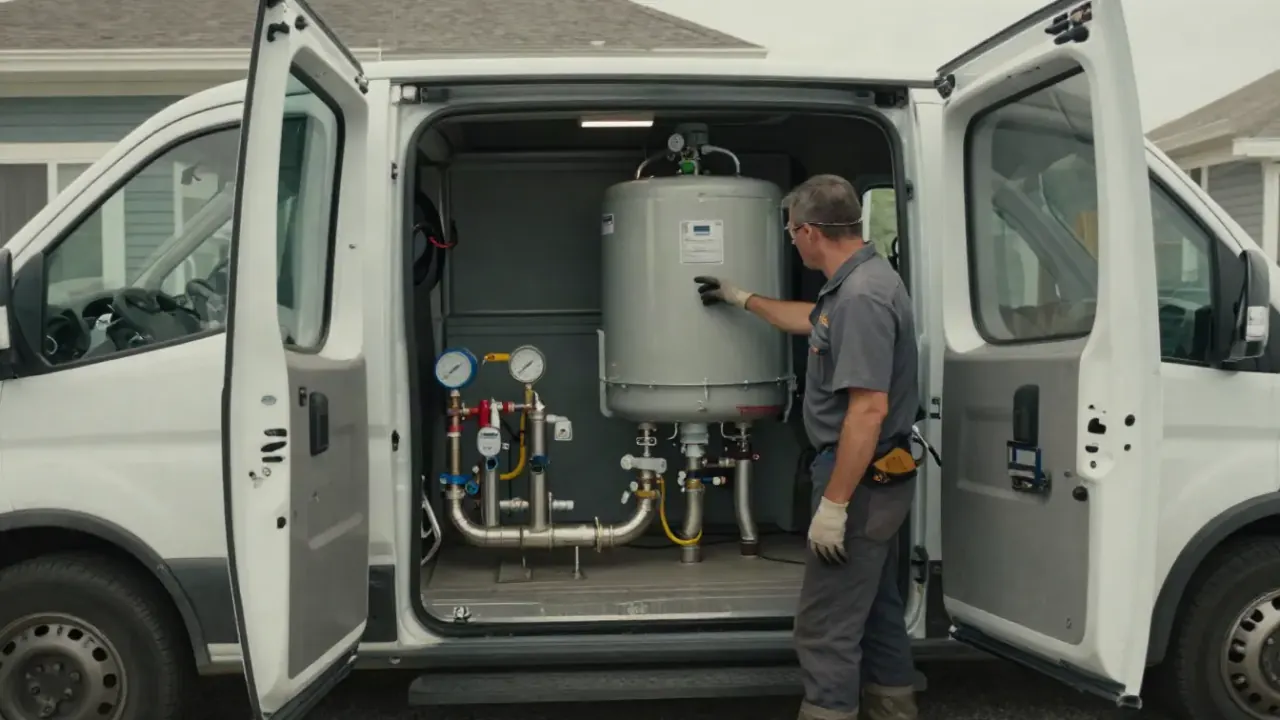
Flush your tankless water heater once every 12 months if you live in Newport Beach on municipal water, and every 6 to 9 months if your unit sits on the harder zones west of the bay or you run a whole-house softener that is past its service date. That is the answer for the vast majority of the roughly 1,400 tankless units we see across Newport Beach each year. The rest of this post explains why the interval moves, what a flush actually removes, what it costs in 2026, and the warning signs that you are already overdue.
How often should you flush a tankless water heater in Newport Beach CA is really a question about your water, not your brand. A Rheem, Rinnai, Navien, and Noritz all scale up at roughly the same rate when the calcium carbonate in the supply is the same. So we start every maintenance conversation with the water, then set the calendar.
The Short Answer for Newport Beach Homes
Newport Beach tankless water heater flush frequency lands at 12 months for most single-family homes and 6 to 9 months for condos and rentals with heavy use. A household of two adults running one shower a day can stretch to 14 or 15 months. A household of five with three teenagers, a laundry running daily, and a pool heater sharing the same gas line should be on the 6-month plan.
Three variables move the number:
- Water hardness. Newport Beach water runs roughly 8 to 12 grains per gallon depending on the zone. Anything over 10 grains pushes you toward the shorter interval.
- Gallons through the unit. A tankless heater rated at 9.5 GPM that flows 180 gallons a day scales faster than one flowing 60.
- Inlet water temperature. Coastal Newport Beach gets 58 to 62°F ground water in winter. Inland zones run colder, which forces the burner to fire harder and accelerates scale on the heat exchanger.
If you have never had the unit flushed and it was installed before 2024, book it now. Scale that has been baking on a copper heat exchanger for three years does not come off with a single 45-minute vinegar cycle.
Why Tankless Heaters Need Flushing at All
Tankless water heater descaling is the process of pumping a mild acid solution through the heat exchanger to dissolve the calcium and magnesium that plate onto the internal water passages. Your supply water carries dissolved minerals. When that water passes through a heat exchanger that hits 300°F on the fire side, the minerals drop out of solution and stick.
On a tank heater, scale settles to the bottom of a 50-gallon tank and you replace the tank every 8 to 12 years. On a tankless unit, scale coats a heat exchanger with water channels roughly the width of a pencil. A layer 1/16 of an inch thick cuts flow and insulates the metal from the flame. The unit then runs longer to hit the same setpoint, which adds more scale. It is a loop, and it is why an annual tankless water heater flush in Newport Beach is not optional maintenance - it is the single thing that decides whether your unit lasts 8 years or 20.
Manufacturers are direct about this. Rinnai, Navien, and Noritz all condition the heat exchanger warranty on documented annual descaling. Skip it, and a failed exchanger that would have been covered becomes a $700 to $1,100 part plus labor on your dime.
How Often Should You Flush a Tankless Water Heater in Newport Beach CA?
Match the interval to your address, because the water changes as you move across the city. Here is how we schedule it for the neighborhoods we serve.
Coastal and Island Properties
Homes on Balboa Island, the Balboa Peninsula, and Lido Isle pull from zones that test closer to 8 to 9 grains per gallon. Those units do well on a strict 12-month cycle. The bigger issue on the islands is salt air and tight mechanical closets - we see more venting and condensate problems there than scale problems, which is why we check the drain line on every visit.
If you own a rental on the peninsula that turns over weekly, the unit is running far more showers than a primary residence. We put those on a 9-month schedule.
Inland and Canyon Neighborhoods
Eastbluff, Big Canyon, Bonita Canyon, and Newport Coast sit on zones that push 10 to 12 grains. Those are the addresses where we recommend 6 to 9 months, and where we strongly suggest a whole-house softener if you do not have one. A softener drops the feed to under 1 grain and lets you go back to a clean 12-month interval.
We also see longer pipe runs in the canyon neighborhoods. Longer runs mean more cold water pushed through the unit before hot water reaches the fixture, which means more heating cycles per shower. That is another nudge toward the shorter interval.
Condos and Multi-Unit Buildings
Condos in Newport Heights, Westcliff, and along Pacific Coast Highway often share a recirculation loop. Recirculation keeps water hot in the lines, but it also keeps water moving through the heat exchanger around the clock. Those units scale faster than a standard point-of-use setup and belong on a 6-month flush.
Does Hard Water in Newport Beach Require More Frequent Flushing?
Yes. Hard water in Newport Beach requires more frequent flushing - 6 to 9 months instead of 12 - because the mineral load is high enough that scale accumulates roughly twice as fast as it does on softened water. The city's imported supply comes largely from the Colorado River and the State Water Project, both of which pick up minerals as they travel. By the time it reaches your meter, you are looking at 8 to 12 grains per gallon and 120 to 180 mg/L of calcium carbonate.
You can check your own number in about five minutes. Buy a $12 hardness test strip kit, run it on a cold kitchen tap, and read the color chart. Under 7 grains, stay on 12 months. Seven to 10, go to 9 months. Over 10, go to 6 months and price a softener.
One more local detail: Newport Beach gets most of its rainfall between December and March. That rain does not change the mineral content of the imported supply much, but it does change how much you run the heater. Winter inlet water drops to 58 to 62°F, the burner fires longer per shower, and scale builds faster from December through March than it does in July. If your flush is due in the fall, do not push it into spring.
Signs Your Tankless Water Heater Is Overdue for a Flush
Watch for these five signals. Any two together mean you are past due, regardless of what the calendar says.
- Hot water takes longer to arrive. If the kitchen tap used to run hot in 12 seconds and now takes 25, flow through the exchanger is restricted.
- Temperature swings in the shower. The classic scale symptom is hot-cold-hot as the unit struggles to modulate.
- Rumbling or kettling. That is steam trapped under a scale layer. It is the same sound a scaled tank makes.
- Error codes. Scale-related codes show up as flow or overheat faults. If your display is throwing codes you have not seen before, that is a strong hint.
- Higher gas bills with no change in use. A scaled exchanger is a less efficient exchanger. A 15% jump in your gas bill with the same habits is worth a look.
If you are seeing any of these, do not wait for the anniversary date. Book the flush and let a technician confirm whether the exchanger is still healthy.
What Happens If You Don't Flush Your Tankless Water Heater in Newport Beach California
Nothing dramatic happens in month 13. The damage is cumulative, and it shows up in three stages.
Stage one, months 12 to 24. Flow restriction and efficiency loss. You notice longer waits and slightly higher gas bills. The unit still works, so most homeowners do nothing.
Stage two, years two to four. The heat exchanger overheats because the flame cannot transfer heat through the scale layer. You start seeing error codes, temperature swings, and eventually a shutdown mid-shower. This is where we get most of our emergency calls.
Stage three, years four and beyond. The exchanger cracks or the water passages plug entirely. At that point the repair is a heat exchanger replacement - $700 to $1,100 in parts alone in 2026, plus labor - or a full unit replacement at $1,800 to $3,200 installed. Neither is covered by warranty if you cannot show annual descaling.
We have pulled exchangers out of Newport Beach units that were five years old and looked like they had been soaking in a mineral bath. We have also pulled 15-year-old exchangers that were nearly clean because the owner flushed every spring. Same city, same water, different outcome.
How Much Does a Tankless Water Heater Flush Cost in Newport Beach?
A professional tankless water heater flush in Newport Beach runs $150 to $300 in 2026 for a standard residential unit. That covers the pump, the descaling solution, the inlet filter screen, and a flow and temperature check on the way out.
What moves the price:
- Unit accessibility. A unit in an open garage is a 45-minute job. A unit buried behind a water softener in a closet under a staircase takes longer.
- Number of units. Two-unit homes and larger properties get a per-unit discount.
- Condition. A heavily scaled unit may need two descaling cycles, which adds $50 to $100.
- Bundle. If the flush is paired with a repair or a replacement, we fold the labor into the larger job.
Compare that to a $700 to $1,100 heat exchanger replacement or a $1,800 to $3,200 new unit, and the math is obvious. A $200 annual flush over 15 years is $3,000. Skipping it and replacing the unit twice in the same window is $4,000 to $6,000 plus two install days.
If you would rather do it yourself, a descaling kit with a submersible pump, two hoses, and a bucket runs $120 to $180, and food-grade white vinegar runs about $4 a gallon. You will need 3 to 4 gallons for a typical residential unit. That is a real option for a confident homeowner with a clean, accessible install. It is not a good option for a unit on a recirculation loop, a unit with a condensate line you have never serviced, or anything throwing codes.
Common Mistakes We See on DIY Flushes
Most DIY flush failures come down to five errors, and every one of them is avoidable.
Using the wrong acid. Vinegar is fine for routine maintenance. Muriatic acid or pool acid is not - it will eat the exchanger and void your warranty. If the scale is heavy enough that vinegar will not touch it, that is a professional job.
Skipping the inlet filter. The small screen on the cold inlet catches debris that would otherwise lodge in the exchanger. Pull it, rinse it, and reinstall it. We find fully clogged screens on about one in four units we open.
Not isolating the unit. You have to close the cold inlet valve, close the hot outlet valve, and open the pressure relief valve before you connect the pump. Skip the isolation and you push descaling solution into your home's plumbing.
Running the pump for 15 minutes and calling it done. A proper flush runs 45 to 60 minutes, and on a scaled unit we reverse the flow direction halfway through to hit both sides of the exchanger.
Forgetting the condensate line. On a condensing unit, the condensate trap and drain line need flushing too. A blocked condensate line shuts the unit down with a fault code that looks like a flame failure.
If any of that sounds like more than you want to take on, that is a normal reaction. Most of our flush customers started out planning to DIY it.
When to Call a Professional
Call us when the unit is throwing error codes, when hot water pressure has dropped noticeably, when you smell anything unusual near the unit, or when the flush is simply past due and you want it done right the first time. We handle the full job - isolation, descaling, filter cleaning, flow test, and a written record of the service date so your warranty file stays intact.
We also check the things a flush alone will not catch: gas pressure at the inlet, venting condition, and the condensate drain. A tankless unit is a system, not just a heat exchanger. If we find a venting or gas issue during a routine flush, we tell you on the spot and give you a straight price before any additional work starts.
For homeowners who want the schedule handled for them, our team can set a recurring reminder and handle the flush every 12 months so it never lands on your to-do list again.
Frequently Asked Questions
How often should you flush a tankless water heater in Newport Beach CA?
Every 12 months for most Newport Beach homes on municipal water. Go to 6 to 9 months if your zone tests over 10 grains per gallon, if you have a large household, or if the unit is on a recirculation loop. Inland canyon neighborhoods and condo buildings fall into the shorter interval.
Does hard water in Newport Beach require more frequent flushing?
Yes. Newport Beach water runs roughly 8 to 12 grains per gallon, which is hard enough to cut the interval from 12 months to 6 or 9. A whole-house softener brings the feed under 1 grain and lets you return to a standard annual schedule.
What happens if you don't flush your tankless water heater in Newport Beach California?
Scale builds on the heat exchanger, flow drops, efficiency falls, and the unit starts throwing error codes within two to four years. Left long enough, the exchanger fails - a $700 to $1,100 part in 2026 - and the warranty will not cover it without documented annual descaling.
How much does a tankless water heater flush cost in Newport Beach?
Professional flushes run $150 to $300 in 2026 for a standard residential unit, including the descaling solution, inlet filter cleaning, and a flow and temperature check. Heavy scale that needs a second cycle adds $50 to $100.
Can I flush my own tankless water heater?
Yes, if the unit is accessible and not throwing codes. A descaling kit costs $120 to $180 and you will need 3 to 4 gallons of white vinegar. Do not use muriatic or pool acid, and do not skip the inlet filter or the condensate line on a condensing unit.
Get Help With Tankless Water Heater in Newport Beach
If your flush is due, overdue, or you are not sure when it was last done, we can check the exchanger, clean the inlet filter, and reset your maintenance calendar in a single visit. We work across Newport Beach and the surrounding coastal neighborhoods, and we will tell you straight whether your unit needs a flush, a repair, or a replacement.
Call (949) 670-0280 to schedule your tankless water heater flush.